
Phishing Analysis
Detailed analysis of captured phishing page
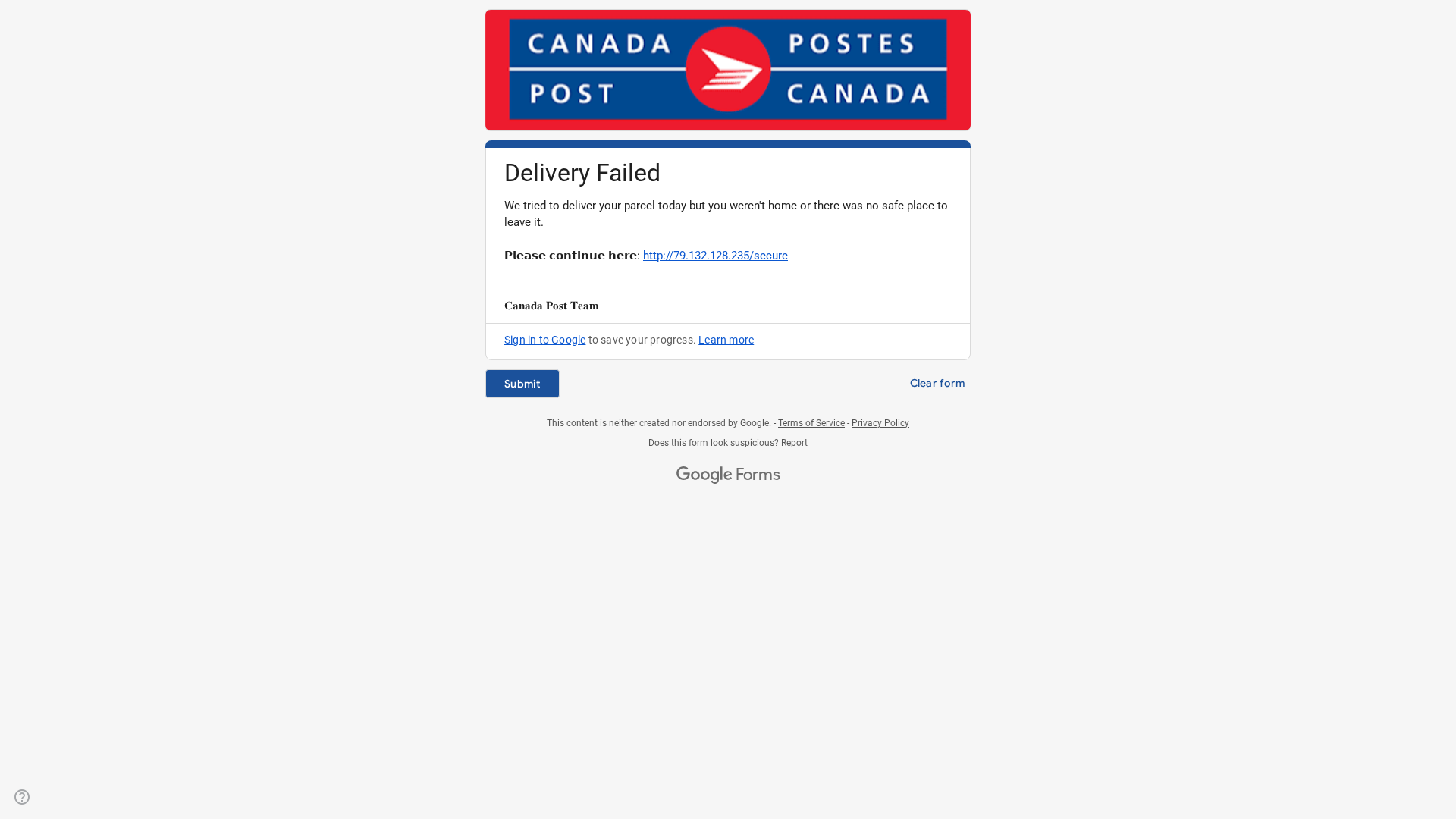
Visual Capture
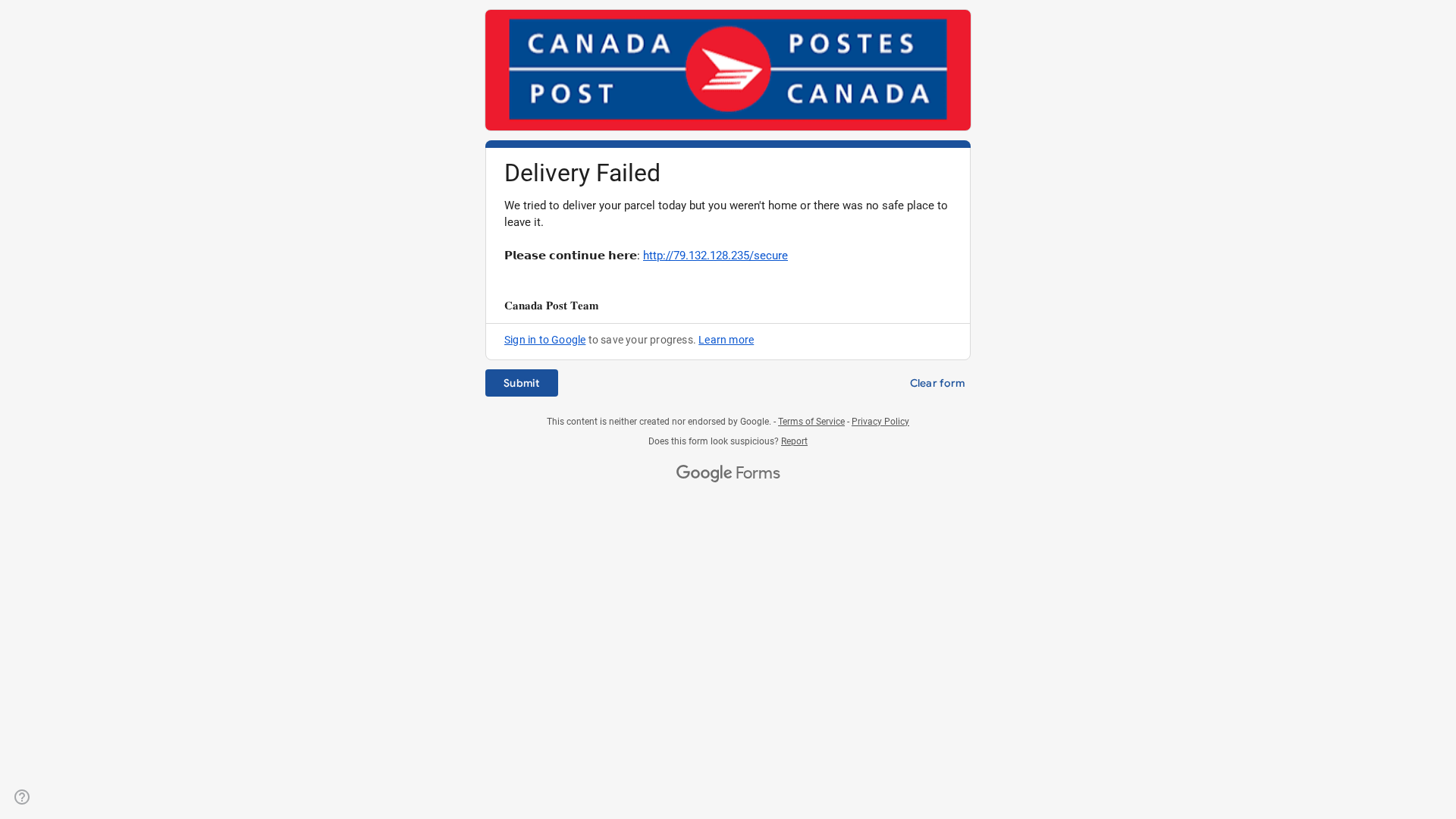
Detection Info
https://docs.google.com/forms/d/e/1FAIpQLSdtq47ivcAiicWXlVJTCFwSi6Eo2JNoRuC-mLdZuzXqdH1B4w/viewform
Detected Brand
Canada Post
Country
Canada
Confidence
100%
HTTP Status
200
Report ID
e1f1ee3a-2d3…
Analyzed
2026-02-23 14:22
Content Hashes (HTML Similarity)
Used to detect similar phishing pages based on HTML content
| Algorithm | Hash Value |
|---|---|
|
CONTENT
TLSH
|
T12F52F973B122BC3B02138AE5B499BB1EB5A3924ECC1F106159BC13D12FECD91B09B746 |
|
CONTENT
ssdeep
|
192:Flh+Hm+iQvI0ogxPorL+AZ+YaEs98tTuBcqauYI/YT5Y1:F+G+UJQQfvs2tTuBcq9YuYVY1 |
Visual Hashes (Screenshot Similarity)
Used to detect visually similar phishing pages based on screenshots
| Algorithm | Hash Value |
|---|---|
|
VISUAL
pHash
|
b13167663470cece |
|
VISUAL
aHash
|
c3c3ffcfffffffff |
|
VISUAL
dHash
|
8e9e60900c280000 |
|
VISUAL
wHash
|
c0c0cccce4f8fc7c |
|
VISUAL
colorHash
|
070000001c2 |
|
VISUAL
cropResistant
|
8e9e60900c280000,71ccd43313941561 |
Code Analysis
Risk Score
85/100
Threat Level
ALTO
⚠️ Phishing Confirmed
🎣 Credential Harvester
🎣 OTP Stealer
🎣 Banking
🎣 Personal Info
🔬 Threat Analysis Report
• Threat: Impersonation/Phishing
• Target: Canada Post customers
• Method: Deceptive Google Form.
• Exfil: The IP address provided. Potential redirection to malicious site.
• Indicators: IP address in link, brand impersonation.
• Risk: High
🔐 Credential Harvesting Forms
🔒 Obfuscation Detected
- atob
- eval
- fromCharCode
- unescape
- hex_escape
- unicode_escape
- base64_strings
📤 Form Action Targets
- https://docs.google.com/forms/d/e/1FAIpQLSdtq47ivcAiicWXlVJTCFwSi6Eo2JNoRuC-mLdZuzXqdH1B4w/formResponse
📊 Risk Score Breakdown
Total Risk Score
90/100
Contributing Factors
Brand Impersonation
The form attempts to impersonate Canada Post.
Suspicious Link
The link uses an IP address, not a legitimate Canada Post domain.
Use of Google Forms for a Likely Attack
The combination of the above with a Google Form adds suspicion.
🔬 Comprehensive Threat Analysis
Threat Type
Banking Credential Harvester
Target
Canada Post users (Canada)
Attack Method
Brand impersonation + credential harvesting forms + obfuscated JavaScript
Exfiltration Channel
HTTP POST to backend
Risk Assessment
CRITICAL - Automated credential harvesting with HTTP POST to backend
⚠️ Indicators of Compromise
- Kit types: Credential Harvester, OTP Stealer, Banking, Personal Info
- 32 obfuscation techniques
🏢 Brand Impersonation Analysis
Impersonated Brand
Canada Post
Official Website
https://www.canadapost-postescanada.ca/cpc/en
Fake Service
Delivery Notification
Fraudulent Claims
⚔️ Attack Methodology
Primary Method: Brand Impersonation / Phishing
The attacker creates a Google Form designed to look like a communication from Canada Post. The user is prompted to click a malicious link to resolve a delivery issue.
Secondary Method: Social Engineering
The email uses a sense of urgency (delivery failed) to trick the user into clicking the link.
🌐 Infrastructure Indicators of Compromise
Domain Information
Domain
None
Registered
None
Registrar
None
Status
None
🤖 AI-Extracted Threat Intelligence
Similar Websites
Pages with identical visual appearance (based on perceptual hash)
Canada Post
https://docs.google.com/forms/d/e/1FAIpQLSfAyG1v16WNNBUXPCJv...
Apr 08, 2026
Canada Post
https://docs.google.com/forms/d/e/1FAIpQLSfAyG1v16WNNBUXPCJv...
Apr 08, 2026
Canada Post
https://docs.google.com/forms/d/e/1FAIpQLSft7PEJQXwXtty1273W...
Mar 31, 2026
Canada Post
https://docs.google.com/forms/d/e/1FAIpQLSft7PEJQXwXtty1273W...
Mar 31, 2026
Canada Post
https://docs.google.com/forms/d/e/1FAIpQLSehUy5Q9w5cydS-2vAO...
Mar 17, 2026
Scan History for docs.google.com
Found 10 other scans for this domain
-
https://docs.google.com/drawings/d/1sj4whBVnBiYbBM...
https://docs.google.com/drawings/d/1yLlUaHnTsx9QSl...
https://docs.google.com/drawings/d/1HkX3Q8Vmr0bSej...
https://docs.google.com/drawings/d/1RCgegAUJGIZOBP...
https://docs.google.com/drawings/d/18Q2Qo6ik56ER5d...
https://docs.google.com/drawings/d/1LyvbqGTLtDzf81...
https://docs.google.com/drawings/d/1QKtwKh3JuUaEHs...
https://docs.google.com/drawings/d/1fL_fne4OgKiCLk...
https://docs.google.com/drawings/d/16f_LOTLDkqMT1D...
https://docs.google.com/drawings/d/11hOe-NpeBFsnAL...

"I Never Thought It Would Happen to Me"
That's what 2.3 million victims say every year. Don't wait to become a statistic.