
Phishing Analysis
Detailed analysis of captured phishing page
Visual Capture
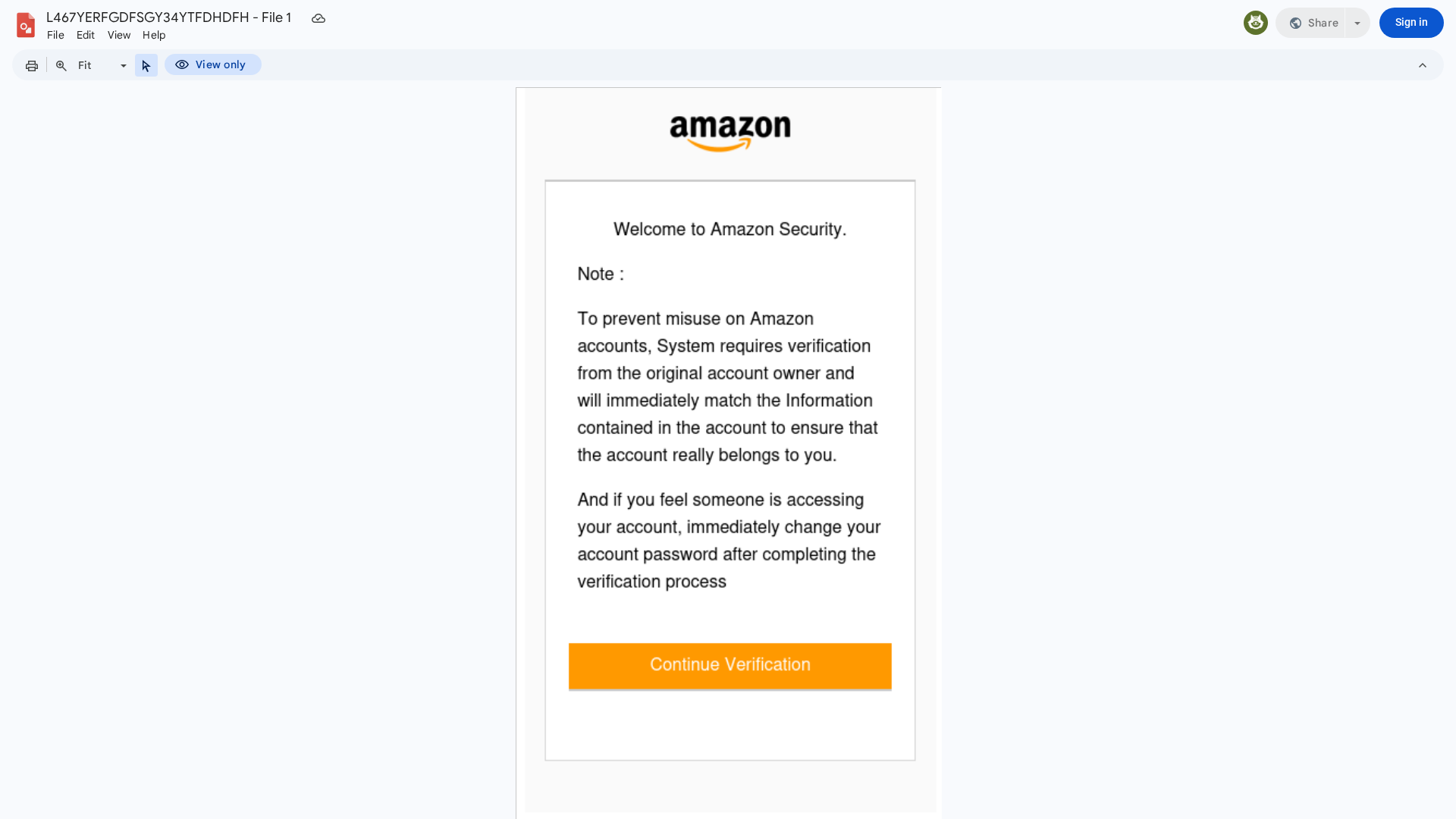
Detection Info
https://docs.google.com/drawings/d/1qkPsN48268HP_s3C66pzfbs4_J3SZSTiQOrbAryZwfE/edit
Detected Brand
Amazon
Country
USA
Confidence
100%
HTTP Status
200
Report ID
f7d35fb0-70b…
Analyzed
2026-03-04 17:00
Content Hashes (HTML Similarity)
Used to detect similar phishing pages based on HTML content
| Algorithm | Hash Value |
|---|---|
|
CONTENT
TLSH
|
T1B0231133C0132132525B52E9F8A0775A2293C32EDE4708491B7CDB913BEBDAA798795D |
|
CONTENT
ssdeep
|
768:mBR4/CIi8L1t/khJ6a+co6v+c6o4IE/Irb5dEoGEqOzVWsPk6TRC1mX6nwCT8v:MR4aIrL1t/2J6fco6Gc6o4L/Irb5dEoN |
Visual Hashes (Screenshot Similarity)
Used to detect visually similar phishing pages based on screenshots
| Algorithm | Hash Value |
|---|---|
|
VISUAL
pHash
|
b3154c555555dd54 |
|
VISUAL
aHash
|
26e7ffe7e7e7e7ff |
|
VISUAL
dHash
|
cc0d484c4c4c4c20 |
|
VISUAL
wHash
|
00c7c7c70707071f |
|
VISUAL
colorHash
|
07000030000 |
|
VISUAL
cropResistant
|
cc0d484c4c4c4c20 |
Code Analysis
Risk Score
85/100
Threat Level
ALTO
⚠️ Phishing Confirmed
🎣 Credential Harvester
🎣 OTP Stealer
🎣 Card Stealer
🎣 Banking
🎣 Personal Info
🔬 Threat Analysis Report
• Threat: Phishing
• Target: Amazon users
• Method: Impersonation through a malicious Google Docs document.
• Exfil: Unknown (likely credentials)
• Indicators: Google Docs URL, suspicious content, JavaScript obfuscation.
• Risk: HIGH
🔒 Obfuscation Detected
- atob
- eval
- fromCharCode
- unescape
- document.write
- hex_escape
- unicode_escape
- base64_strings
📡 API Calls Detected
- GoogleDocs
- a
- footer
- hr
- /videos/u/0/debug/fetchmediafromfilestorage?mediaId=
- h2
- ol
- kbd
- POST
- td
- p
📊 Risk Score Breakdown
Total Risk Score
90/100
Contributing Factors
Domain Mismatch
The domain (docs.google.com) does not belong to Amazon.
Suspicious Content
The content requests account verification, a common phishing tactic.
JavaScript Obfuscation
Obfuscated code detected, indicating an attempt to hide malicious functionality.
🔬 Comprehensive Threat Analysis
Threat Type
Banking Credential Harvester
Target
Amazon users (USA)
Attack Method
Brand impersonation + credential harvesting forms + obfuscated JavaScript
Exfiltration Channel
Form submission (backend endpoint not detected - likely JavaScript-based)
Risk Assessment
CRITICAL - Automated credential harvesting with Form submission (backend endpoint not detected - likely JavaScript-based)
⚠️ Indicators of Compromise
- Kit types: Credential Harvester, OTP Stealer, Card Stealer, Banking, Personal Info
- 916 obfuscation techniques
🏢 Brand Impersonation Analysis
Impersonated Brand
Amazon
Official Website
https://www.amazon.com
Fake Service
Amazon Security
Fraudulent Claims
⚔️ Attack Methodology
Primary Method: Credential Harvesting
The attacker aims to steal Amazon account credentials. The user is lured to a fake login page (or a page that will redirect to a fake login page) and tricked into entering their username and password.
Secondary Method: Social Engineering
The message uses a sense of urgency to trick the user into taking immediate action to verify their account, creating a sense of pressure.
🌐 Infrastructure Indicators of Compromise
Domain Information
Domain
docs.google.com
Registered
None
Registrar
None
Status
None
🤖 AI-Extracted Threat Intelligence
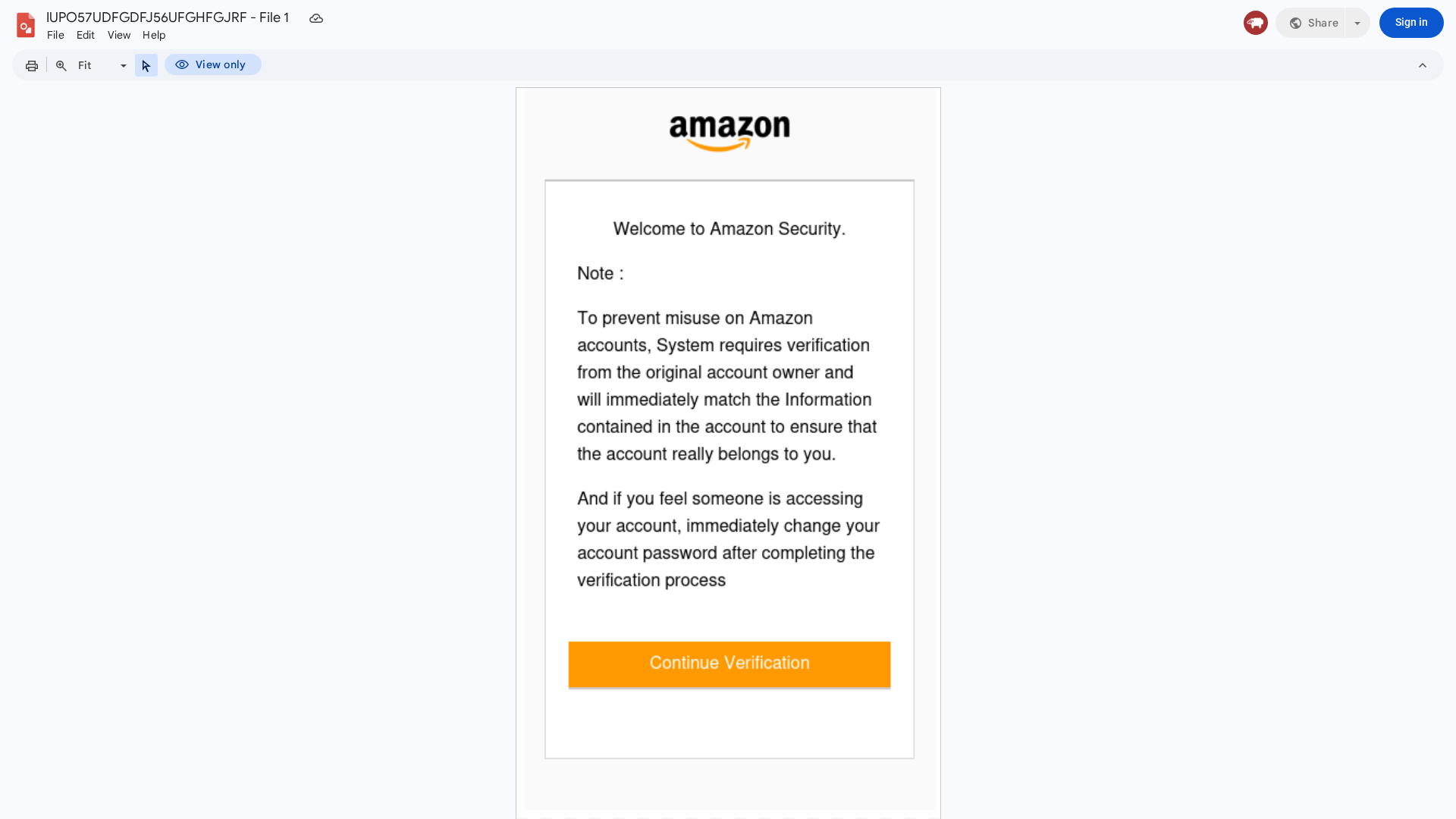
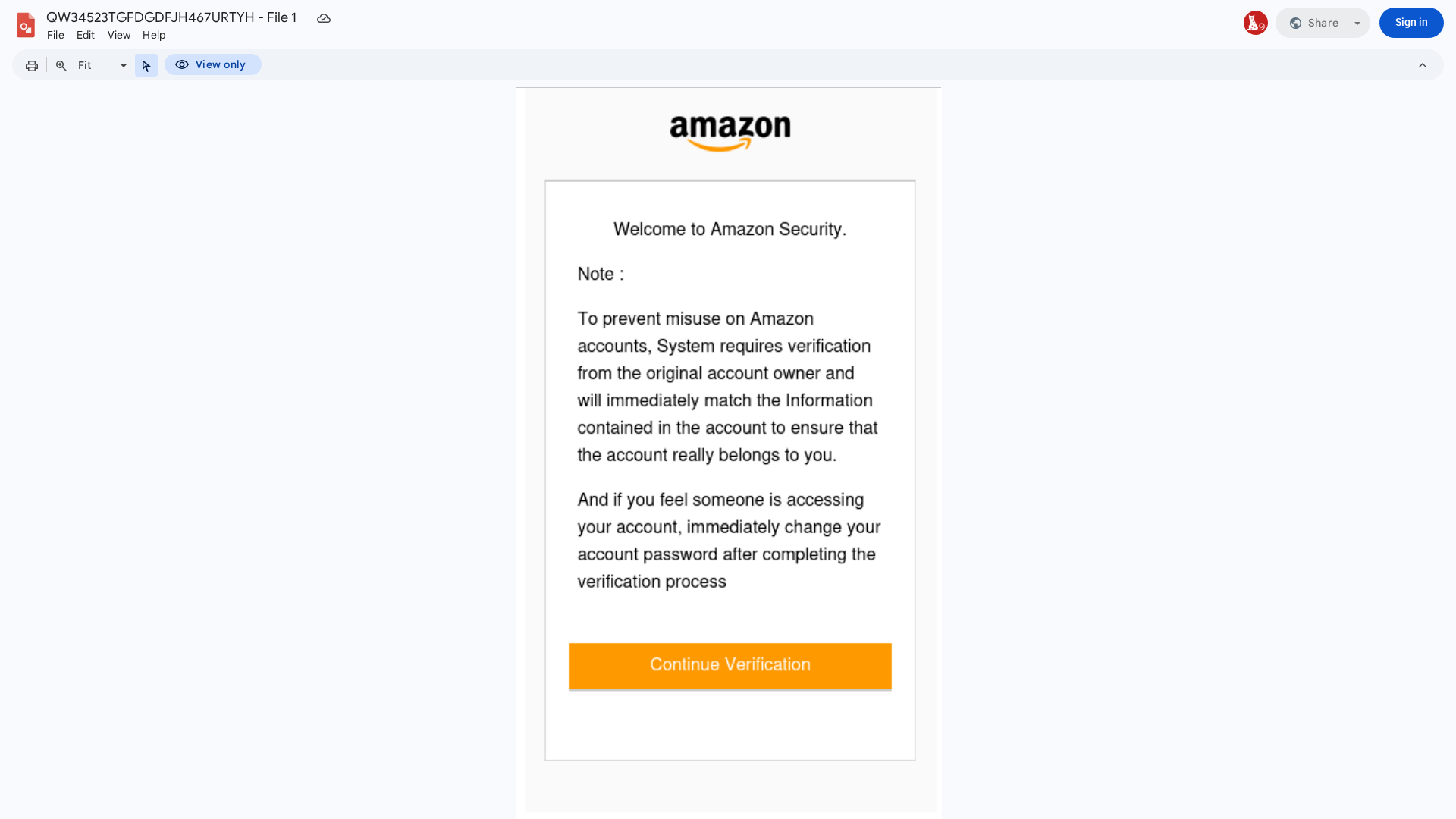
Similar Websites
Pages with identical visual appearance (based on perceptual hash)
Scan History for docs.google.com
Found 10 other scans for this domain
-
https://docs.google.com/drawings/d/1sj4whBVnBiYbBM...
https://docs.google.com/drawings/d/1yLlUaHnTsx9QSl...
https://docs.google.com/drawings/d/1HkX3Q8Vmr0bSej...
https://docs.google.com/drawings/d/1RCgegAUJGIZOBP...
https://docs.google.com/drawings/d/18Q2Qo6ik56ER5d...
https://docs.google.com/drawings/d/1LyvbqGTLtDzf81...
https://docs.google.com/drawings/d/1QKtwKh3JuUaEHs...
https://docs.google.com/drawings/d/1fL_fne4OgKiCLk...
https://docs.google.com/drawings/d/16f_LOTLDkqMT1D...
https://docs.google.com/drawings/d/11hOe-NpeBFsnAL...

"I Never Thought It Would Happen to Me"
That's what 2.3 million victims say every year. Don't wait to become a statistic.